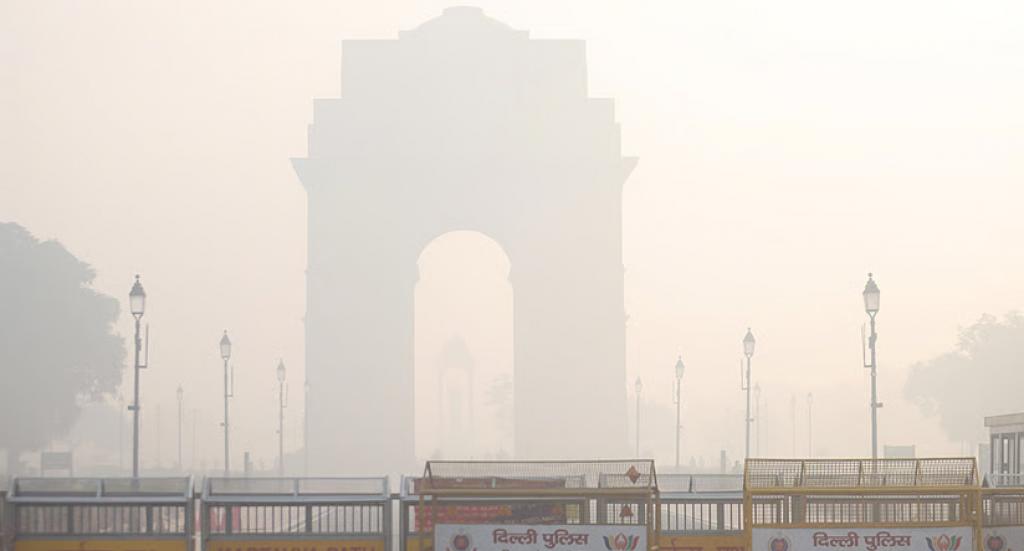
Delhi’s air was already dangerously foul before the first Diwali firecracker was lit. A new analysis by the Centre for Science and Environment (CSE), released today, finds that early-winter pollution (October to mid-November) has worsened in 2026. The emergency traffic curbs imposed by the government have done little to loosen the capital’s choked roads.
The week before Diwali recorded an average PM2.5 concentration of 236 µg/m³, a three-year high. That is 97 per cent above the 120 µg/m³ logged in 2025 and 32 per cent above the 179 µg/m³ in 2024.
“Diwali pollution is an annual tipping point, but elevated particulate levels before the festival show that baseline pollution is higher than in previous years,” said Anumita Roychowdhury, executive director, Research and Advocacy, CSE. “Year-round emission control across key sources remains inadequate.”
Farm fires not the whole story
The data challenges the familiar blame on stubble burning. Delhi’s air slipped into the ‘very poor’ category on November 2. Stubble smoke contributed 3.9 per cent of citywide PM2.5 during GRAP Stage I, rose to 11.5 per cent on November 1, and peaked at a season-high 16.2 per cent on November 4. Yet on November 6, when GRAP Stage III was invoked, the AQI hit 382 even though stubble’s share had fallen to around 8 per cent.
Data from the Indian Institute of Tropical Meteorology’s Decision Support System for November 1-8 shows where the pollution actually came from:
- Neighbouring NCR districts: 54.43 per cent of Delhi’s PM2.5
- Local sources: 33.06 per cent
- Stubble burning: 14.29 per cent
Within Delhi’s own emissions, vehicles dominated at 52 per cent, far ahead of residential activities (13 per cent) and peripheral industries (11 per cent). Construction contributed 7 per cent, energy use and waste burning 5 per cent each, and road dust and other sectors 4 per cent each.
Hotspots: old ones ease, new ones emerge
Eleven of Delhi’s 13 designated hotspots improved between October 1 and November 8 compared with the same period in 2025. Anand Vihar fell 49 per cent, Wazirpur 41 per cent, Ashok Vihar 40 per cent and Bawana 22 per cent. Jahangirpuri (up 2 per cent) and Punjabi Bagh (up 1 per cent) bucked the trend, and Jahangirpuri remains the most polluted designated hotspot at 163 µg/m³.
Meanwhile, non-designated areas are overtaking older danger zones: Vivek Vihar (144 µg/m³), Sonia Vihar (139), ITO (137), DTU (135), NIH Narela (122) and NSUT Jaffarpur (111). The build-up was region-wide, with Gurugram, Faridabad, Noida, Ghaziabad and Greater Noida all seeing a sharp spike in early November.
Evening gridlock traps toxic gas till midnight
Nitrogen dioxide (NO2), around 80 per cent of which comes from vehicles, peaks at 9 AM, dips to its lowest at 2 PM as atmospheric conditions improve, then climbs through the evening rush and stays high until midnight, long after traffic has thinned. “The evening rush loads the air and the still night air keeps it there,” said Sharanjeet Kaur, deputy programme manager, Urban Lab, CSE. Daily NO2 levels rose by one-third from November 2 even though congestion stayed flat.
GRAP curbs bring negligible relief
During the restriction week (November 2-6), Delhi’s average daily Travel Time Index (TTI) was 2.40, with an evening peak of 3.49. This was virtually identical to the 2.38 and 3.48 recorded on October 30, just before the curbs. Commuters took 13 per cent longer than on standard weekdays from January to April, and evening rush hours took 13 to 31 per cent longer. The evening Planning Time Index improved only marginally, from 6.36 to 6.16.
“The rules merely prevented the pre-festive rush from worsening,” said Shubham Srivastava, deputy programme manager, clean air and sustainable mobility, CSE. Weekend traffic did fall 8 per cent below baseline, but largely because of the diesel-truck entry ban, closed offices and residents staying home or travelling out for Chhoti Diwali.
Diwali vs Holi
The two festivals emptied Delhi’s roads very differently. On Holi (March 4, 2026), the TTI averaged 1.15, 46 per cent below a normal weekday. Diwali 2026 averaged 1.32, 29 per cent below a typical Sunday, with an afternoon plateau near 1.5 due to last-minute shopping and visits. The run-up to Diwali saw four straight working days 12 to 21 per cent above baseline congestion, whereas the pre-Holi week stayed at or below normal.
The way forward
CSE warned that weak routine controls are pushing the region into growing dependence on emergency GRAP measures. “Short-term emergency steps cannot substitute for systemic solutions,” Roychowdhury said, calling for deep, year-round emission cuts across transport, industry, construction, waste burning and dispersed urban sources throughout the airshed.
Srivastava said vehicles crawling and idling in traffic burn fuel inefficiently and emit more per kilometre. Clean air plans, he argued, treat vehicles as a tailpipe or routing problem rather than a problem of sheer volume. Real relief will require mass public transit, mandatory trip-reduction measures and stringent car-restraint policies.