

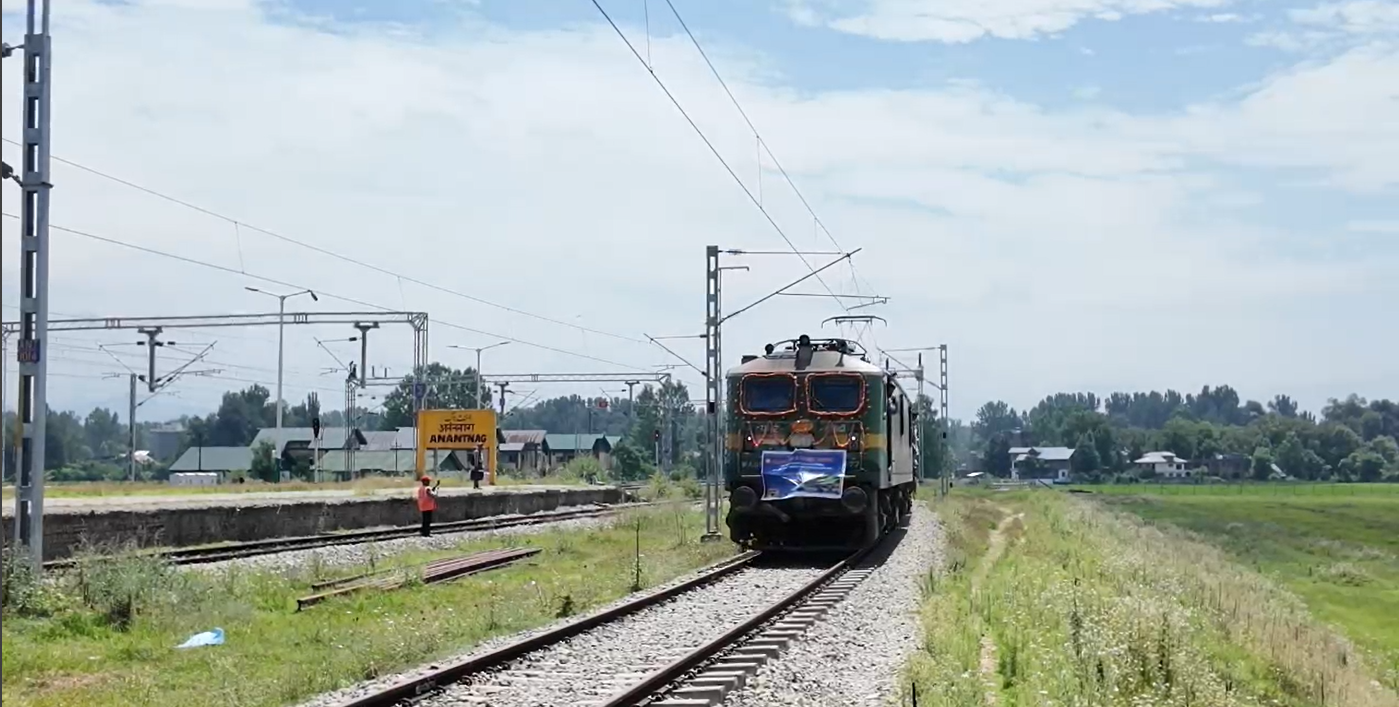
In a historic leap for Jammu and Kashmir’s economic infrastructure, Indian Railways has officially opened the Anantnag Goods Shed for freight operations, marking the arrival of the first-ever freight train in the region. The milestone, achieved on the auspicious occasion of Raksha Bandhan, is being hailed as a transformative step that will deepen trade ties, reduce logistics costs, and strengthen Kashmir’s connectivity with the rest of India.
Great day for commerce and connectivity in Jammu and Kashmir! It will enhance both progress and prosperity. https://t.co/IFLcfmZvuW
— Narendra Modi (@narendramodi) August 9, 2025
The inaugural freight train, loaded with 21 wagons of cement, departed from Gujarat Ambuja Cement Limited (GACL) in Rupnagar, Punjab, and reached the newly commissioned Anantnag Goods Shed in less than 18 hours, covering a distance of approximately 600 kilometers. The cement consignment will directly support key infrastructure and public development projects across the Valley—roads, bridges, housing, and community facilities—at a time when logistical reliability is crucial.
A Nationally Celebrated Moment
The event has drawn widespread praise from national leadership. Prime Minister Narendra Modi, in a repost of Railway Minister Ashwini Vaishnaw’s update on X (formerly Twitter), called it a breakthrough for commerce and development in the Union Territory:
“Great day for commerce and connectivity in Jammu and Kashmir! It will enhance both progress and prosperity.”
Railway Minister Ashwini Vaishnaw emphasized the long-term impact of the development:
“Today (9.8.2025), the first freight train reached the newly commissioned Anantnag Goods Shed from Punjab, marking a significant milestone in connecting the Kashmir Valley to the national freight network. Transportation via the railway will reduce costs for citizens and support sustained development.”
“हमारे ताज़ा फल और माल अब देश के सभी बाज़ारों तक पहुँचेंगे। हम सभी बहुत खुश हैं।” pic.twitter.com/jtLSXpscQy
— Ashwini Vaishnaw (@AshwiniVaishnaw) August 9, 2025
A Precision-Executed Operation
The logistical coordination for the historic freight movement reflected the operational precision of Indian Railways. The request for the rake was submitted on August 7 at 11:14 PM, and placement occurred on August 8 at 9:40 AM. Loading was completed by 6:10 PM, and the train departed at 6:55 PM, hauled by a modern WAG-9 electric locomotive (Loco No. 32177, TKD, Trip 08/09).
The operation not only underscores Indian Railways’ efficiency but also symbolizes its growing technological and infrastructural prowess in difficult terrains like Jammu and Kashmir.
Anantnag Freight Terminal: Gateway to Economic Growth
With the commissioning of the Anantnag Goods Shed under the Jammu Division of Northern Railway, the station will now handle both inward and outward freight from 6:00 AM to 10:00 PM daily. It is equipped to manage all categories of goods, excluding petroleum-based products.
This move is part of the larger Udhampur–Srinagar–Baramulla Rail Link (USBRL) project—an ambitious initiative aimed at fully integrating Kashmir into India’s national rail and trade network. Anantnag joins the vital Baramulla–Srinagar–Banihal corridor, a critical axis for logistics in the Valley.
Historic: First freight train reaches Kashmir pic.twitter.com/fJuSDjcVpY
— Gaon Tribune गांव ट्रिब्यून (@GaonTribune) August 10, 2025
Game-Changing Benefits for Kashmir’s Economy
The freight train service is expected to bring substantial economic and social benefits:
-
-
Reduced Transport Costs: Businesses in Kashmir will now have access to more affordable freight options compared to conventional road transport.
-
Reliable All-Weather Connectivity: The rail link ensures uninterrupted supply chains, particularly during winters when heavy snowfall disrupts road transport.
-
First freight train reaches Kashmir pic.twitter.com/vCjlS9MmyK
— Gaon Tribune गांव ट्रिब्यून (@GaonTribune) August 10, 2025
-
Boost to Local Industries: Kashmiri products such as apples, walnuts, saffron, handicrafts, and paper mache can now be transported faster and fresher to national markets.
-
Employment Generation: Increased freight movement is likely to create direct and indirect job opportunities in warehousing, logistics, cold storage, and allied sectors.
-
Sustainable Development: Rail transport will reduce road traffic congestion and lower carbon emissions, contributing to environmentally responsible growth in the region.
A Broader Rail Revolution in Kashmir
This milestone comes on the heels of other monumental rail achievements in the region. With the completion of the Chenab Bridge, the world’s highest railway bridge, and the full rail link between Katra and Srinagar, Kashmir is now closer than ever to the rest of India—not just in miles, but in markets, mobility, and mutual growth.
Authorities have reassured that all environmental, safety, and security protocols are being stringently followed at the new goods terminal. The station has been designed to handle future expansions and rising demand, making it a cornerstone of Kashmir’s logistical future.
Local Voices Welcome the Change
Local business chambers, trade associations, and residents have warmly welcomed the initiative. Many believe the move will revolutionize how goods are transported to and from the Valley, reduce economic isolation, and give local producers a competitive edge.
“It’s a dream come true. We’ve waited decades for this level of logistical ease. This will change the game for small and large businesses alike,” said a prominent apple trader from Shopian.
Looking Ahead
With the Anantnag Goods Shed now operational, Indian Railways has taken a crucial step toward fulfilling its vision of inclusive development and national integration through infrastructure. As freight services scale up in the coming months, stakeholders across Kashmir are hopeful this will be a springboard for wider industrial activity, investment, and prosperity in the region.