
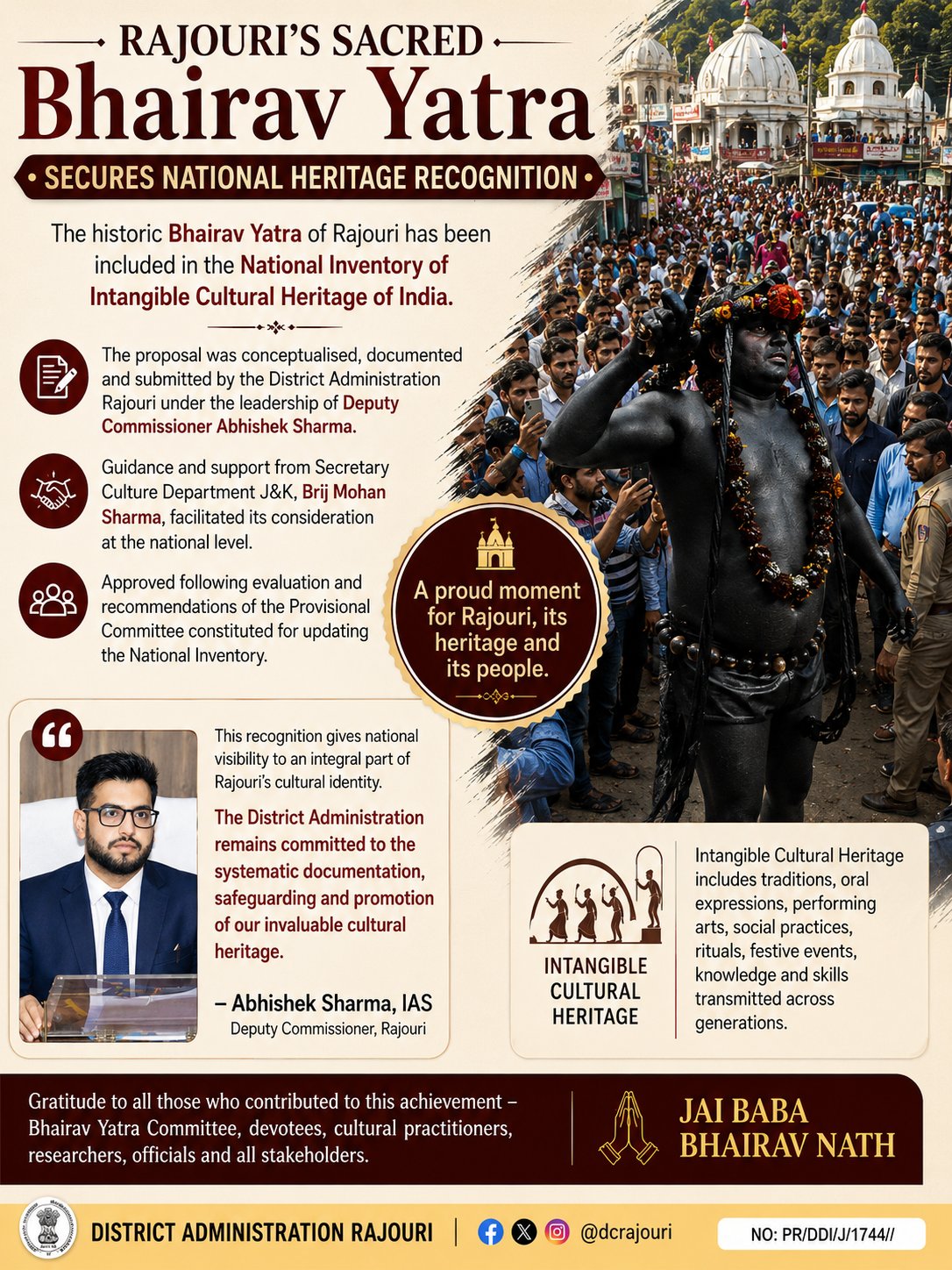
Jammu and Kashmir’s border district of Rajouri has earned national recognition after its historic Bhairav Yatra was officially included in the National Inventory of Intangible Cultural Heritage (ICH) of India, marking a significant milestone in preserving the region’s rich cultural and spiritual traditions.
Lieutenant Governor Manoj Sinha on Wednesday congratulated the Rajouri District Administration and the Department of Culture, Jammu and Kashmir, for achieving the prestigious recognition.
In a post on X, the lieutenant governor described the inclusion as a proud moment for Rajouri and the entire Union Territory.
Proud moment for Rajouri! The district’s historic Bhairav Yatra has officially been added to National Inventory of Intangible Cultural Heritage of India. Congratulations to the Rajouri District Administration and the J&K’s Department of Culture for turning this dream into a… pic.twitter.com/RCykJRZ5zV
— Manoj Sinha (@manojsinha_) July 15, 2026
“Proud moment for Rajouri! The district’s historic Bhairav Yatra has officially been added to the National Inventory of Intangible Cultural Heritage of India. Congratulations to the Rajouri District Administration and the J&K Department of Culture for turning this dream into a reality,” he wrote.
Sinha said the recognition would play a vital role in documenting, preserving, and promoting the region’s deep-rooted spiritual and cultural heritage. He noted that the honour acknowledged the generations of devotees who have kept the centuries-old tradition alive.
“The inclusion of Bhairav Yatra in the National Inventory of Intangible Cultural Heritage will strengthen Rajouri’s unique cultural identity at the national level while opening new avenues for research, cultural exchange, and sustainable heritage tourism,” he added.
The Bhairav Yatra is only the second cultural tradition from Jammu and Kashmir to be included in the National Inventory of Intangible Cultural Heritage. Earlier, “Buddhist Chanting of Ladakh: Recitation of Sacred Buddhist Texts in the Trans-Himalayan Ladakh Region” had received the same recognition.
Welcoming the development, eminent writer and social activist Mantoo Dutta Sharma termed it a matter of immense pride for the people of Jammu and Kashmir, particularly the residents of Rajouri.
“Ask the elders of Rajouri, and they will tell you they have witnessed it since childhood. The tradition has been passed down uninterrupted through generations, while the legend behind it continues to survive in local memory like scripture.”
A native of Rajouri, Sharma has extensively researched and documented the Bhairav Yatra through numerous articles and research papers. For years, she has highlighted its historical significance, cultural uniqueness, and spiritual importance.
Speaking about the origins of the tradition, she said no one can accurately determine when the Bhairav Yatra began.
“Ask the elders of Rajouri, and they will tell you they have witnessed it since childhood. The tradition has been passed down uninterrupted through generations, while the legend behind it continues to survive in local memory like scripture,” she said.
According to local folklore, Rajouri was once devastated by a severe famine. During that difficult period, a mysterious saint appeared before the people and advised them to organise the Bhairav Jhanki every year on the eve of Holi and seek the blessings of Bhairav Dev. The saint assured them that prosperity would return if the ritual was observed with devotion.
The people followed his advice, and, according to the legend, the famine ended. Since then, the Bhairav Jhanki has been celebrated every year without interruption and has become the ceremonial beginning of Rajouri’s week-long Holi festivities.
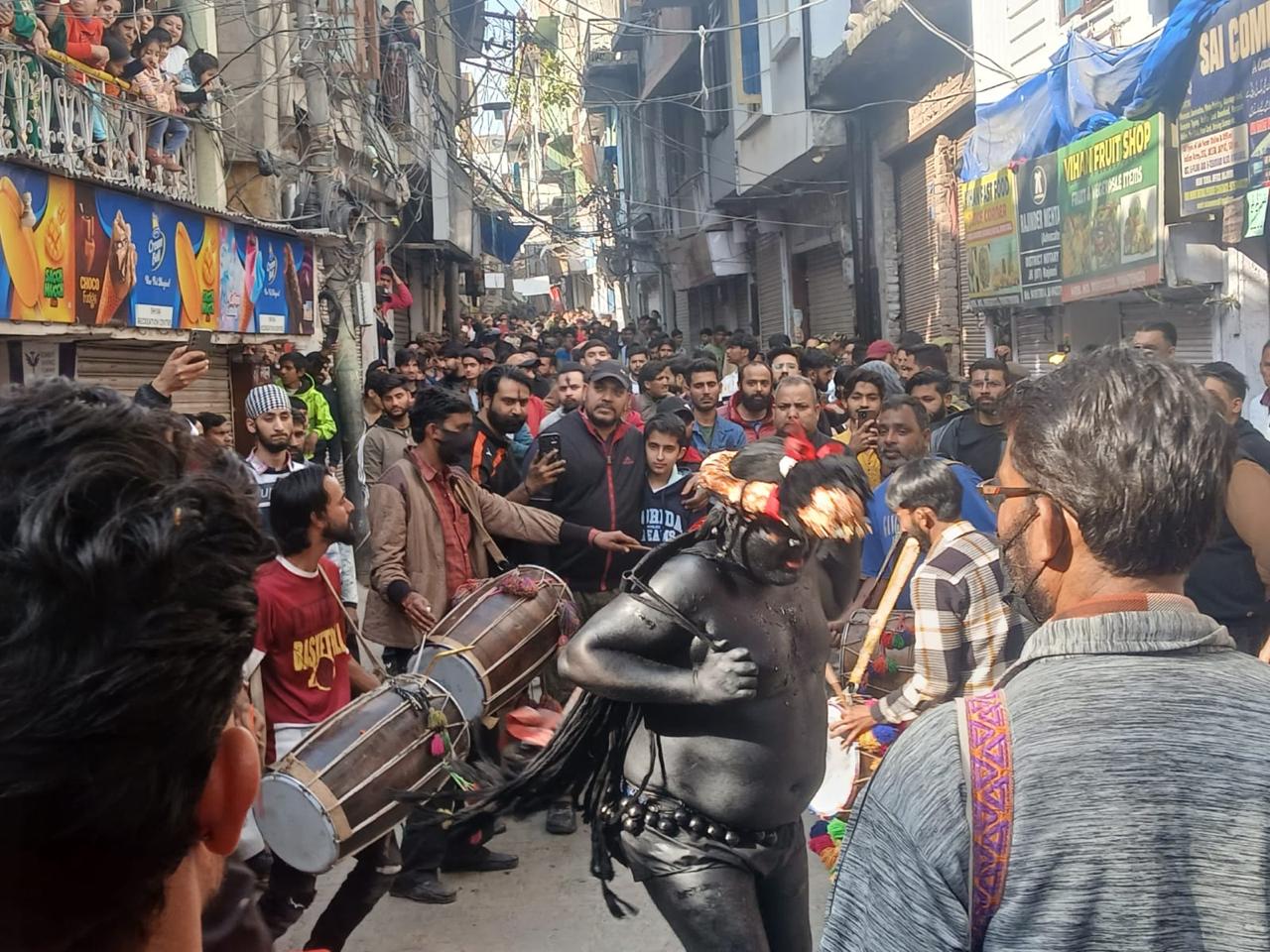
Sharma explained that the individual portraying Bhairav Baba is first taken to the Devi Temple, where his body is covered with a black paste symbolising strength and spiritual power. He is then handed a chimta (iron tongs), believed to ward off evil, before leading the procession through the town to the rhythmic beats of traditional drums.
His long flowing hair, traditional ornaments, and striking appearance create a powerful visual representation of the deity, attracting hundreds of devotees who dance alongside him in celebration.
The procession halts at two sacred sites—Bhairon Sthan at Nikki Tawi and Bhairon Sthan at Naban Mohalla—where devotees offer prayers to the stone form of Bhairav Baba. Beginning in the afternoon, the procession moves through various parts of Rajouri town before concluding at Devi Dwar in the evening. The celebrations continue until Holi.
Devotees consider it auspicious to receive a black tilak from Bhairav Baba and a symbolic touch on the back with the iron tongs, believing it brings divine blessings and protection for the year ahead.
One of the most remarkable aspects of the Bhairav Yatra is the overwhelming public participation. Hundreds of young people dance around the central figure of Bhairav Baba amid devotional songs and traditional music, while women gather on rooftops to witness the vibrant procession and offer prayers.
Social activist Tazeem Dar, who has consistently worked for the preservation of the cultural and ecological heritage of the twin border districts of Rajouri and Poonch, said the inclusion was a proud moment for the entire Pir Panchal region.
“The inclusion of the Bhairav Yatra in the National Inventory of Intangible Cultural Heritage recognises our region’s unique cultural traditions and folklore. It is a living symbol of faith, communal harmony and shared heritage, as people from all communities participate in the celebrations,” Dar said.
He added that Rajouri and the wider Pir Panchal region continue to stand as shining examples of communal harmony, brotherhood and peaceful coexistence.
Perhaps the greatest strength of the Bhairav Yatra lies beyond its religious significance. In a border district where Hindus and Muslims have lived together for generations, the annual procession brings people from different communities together in a shared celebration of faith, culture and unity.
At a time when border regions are often associated with conflict, Rajouri’s centuries-old Bhairav Yatra continues to reflect a different identity—one rooted in peace, prosperity, brotherhood and an enduring tradition of communal harmony.