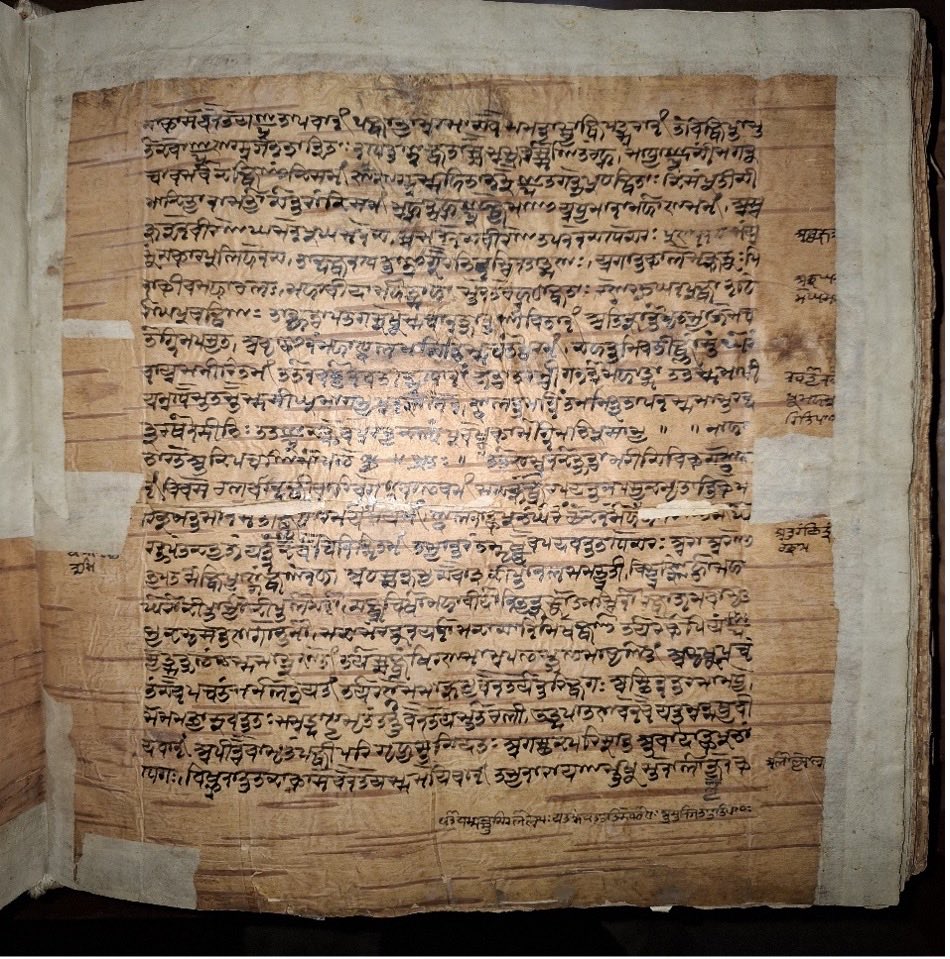
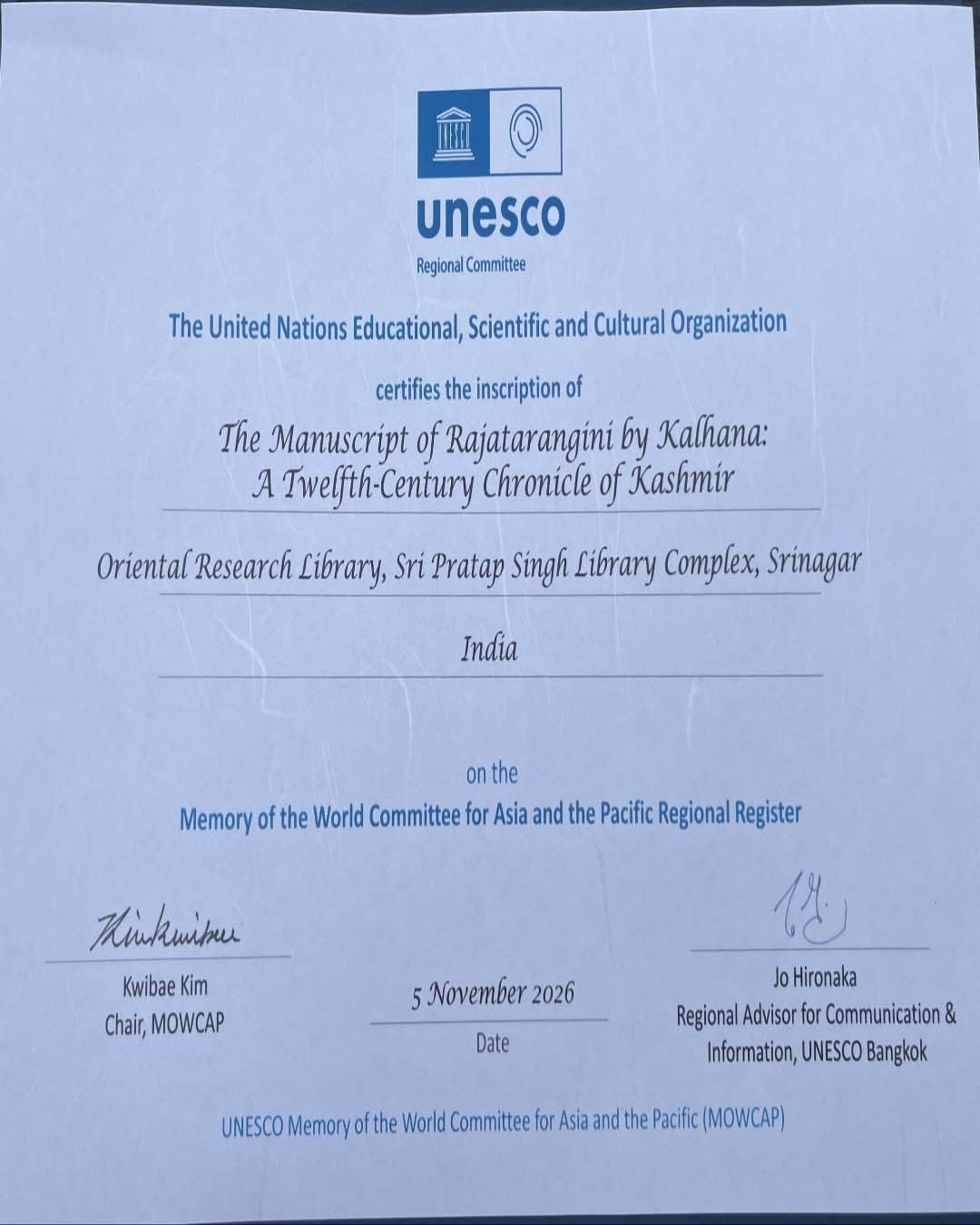
A 12th-century manuscript that has guarded Kashmir’s past for centuries now has a place on the world stage. Kalhana’s Rajatarangini has been inscribed on UNESCO’s Memory of the World Asia-Pacific Regional Register, bringing international recognition to one of the region’s most significant historical works.
Two other Indian texts, the Mahabharata and Kautilya’s Arthashastra, a treatise on governance and statecraft, were inscribed alongside it. Of the three, the Rajatarangini and the Mahabharata are directly tied to Kashmir’s knowledge tradition, its Sharada script and its manuscript heritage.
The manuscript of the Rajatarangini is preserved at the Oriental Research Library in Srinagar. Written in Sanskrit, the text is regarded as a landmark of history writing in Indian literature. It gives a systematic account of Kashmir’s kings, dynasties, political developments, and social and cultural life. Kalhana did not merely record the achievements of rulers; he attempted to present history as an account of events.
The Mahabharata link to the Valley is just as striking. A rare manuscript of about 400 years old, written in Sharada script on birch bark, is now preserved at the Bhandarkar Oriental Research Institute in Pune. According to UNESCO, it was discovered in Kashmir by Georg Bühler in 1875. It is considered important evidence of the ancient Kashmiri version of the epic. It also shows how the Sharada script and the Valley’s tradition of writing on birch bark helped preserve a key text of the Indian epic tradition.
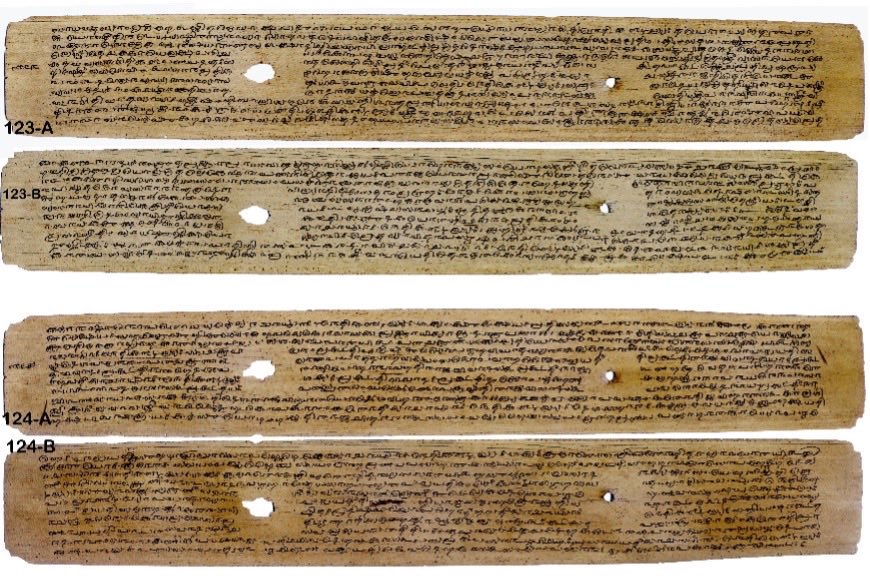
Sharada has long been an important script for Sanskrit writing in Kashmir and the wider northwestern Indian subcontinent. Manuscripts on birch bark and old Kashmiri paper testify to the region’s centuries-old tradition of scholarship, literature and the preservation of knowledge. That learning did not stay confined to scriptures; it reached ordinary people through proverbs and folk tales.
The recognition shows that Kashmir is not only a land of natural beauty and tourism, but also a major centre of India’s ancient writing and knowledge traditions.
Lieutenant Governor Manoj Sinha and Chief Minister Omar Abdullah both welcomed the development as a proud moment for the people of Jammu and Kashmir.
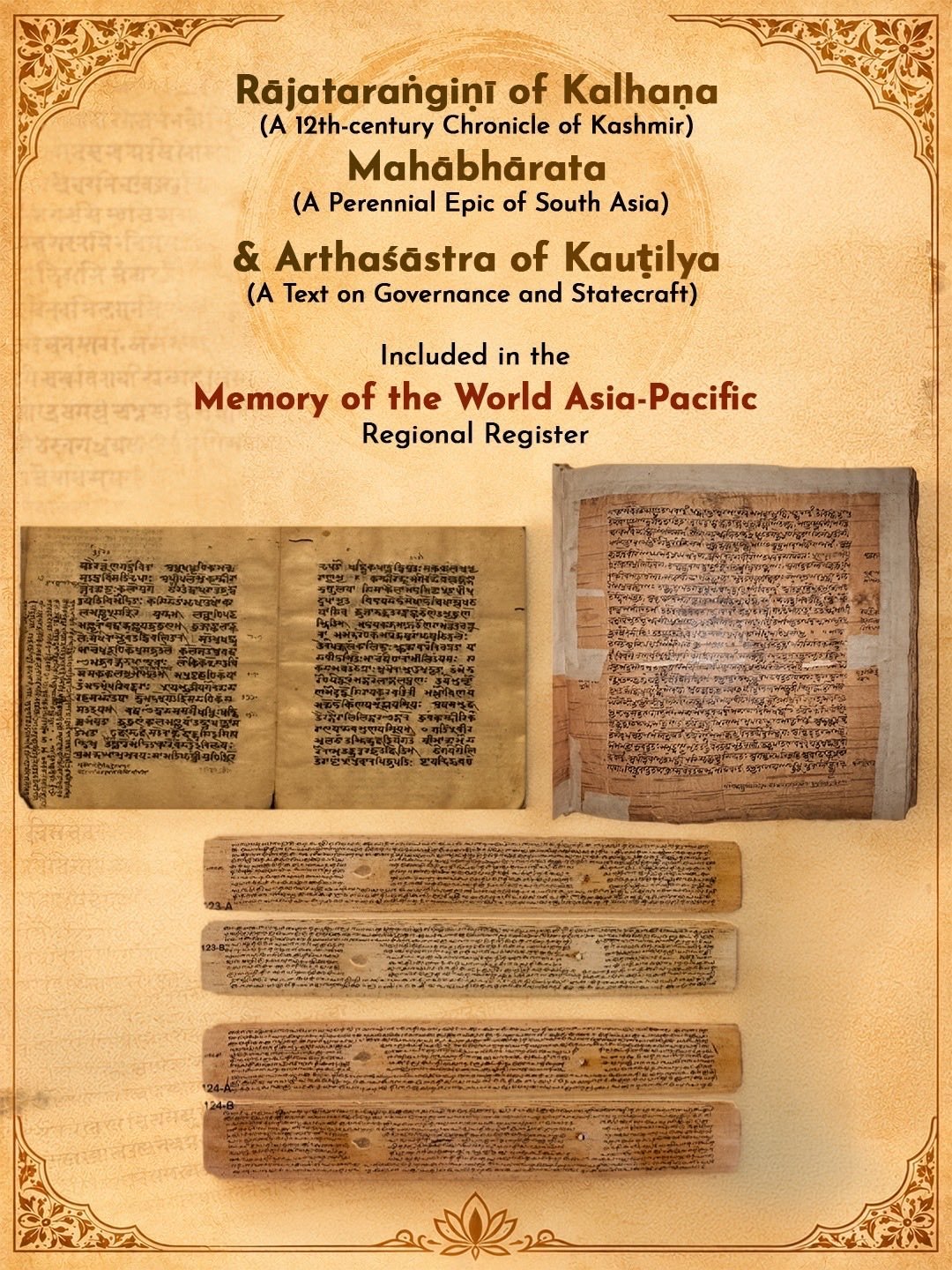
“Proud moment for Jammu Kashmir & the nation! Kalhaṇa’s Rajatarangini, Mahabharata & Arthasastra have been inscribed in UNESCO’s Memory of the World Asia-Pacific Regional Register,” the Office of the LG posted. It added that the inclusion of the Rajatarangini celebrates the Union Territory’s rich intellectual heritage, and that the recognition “reaffirms the timeless value of India’s civilisational traditions and their contribution to humanity.”
The Chief Minister’s Office, in a post on its official social media handle, said Omar Abdullah congratulated the people of Jammu and Kashmir on the inscription of the 12th-century manuscript. It described the manuscript as “an invaluable repository of Kashmir’s historical and cultural tradition,” and said the recognition underscores the importance of preserving the region’s heritage.