
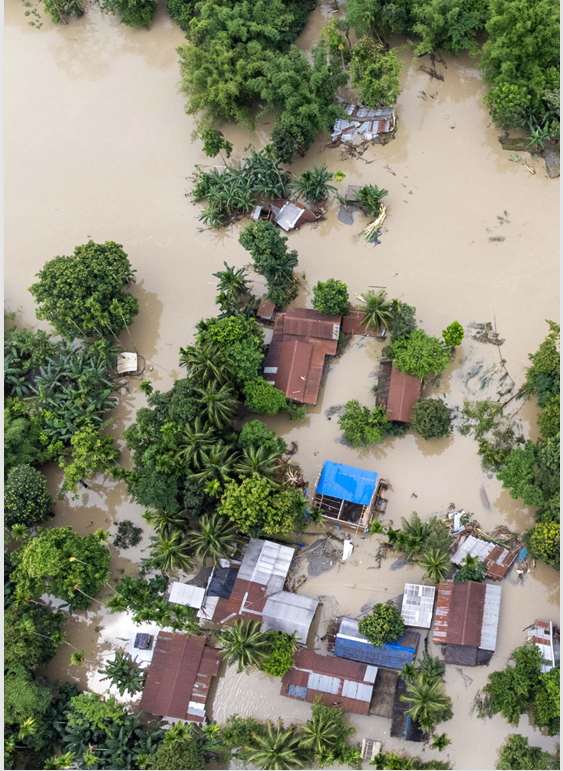
India was hit by an extreme weather event on 92 per cent of the days in the first nine months of 2026, claiming 3,220 lives and leaving a trail of ruined farms, flattened homes and mounting debt, according to a new report by the Centre for Science and Environment (CSE) and Down To Earth.
Released today at a webinar, Climate India 2026 tallies the toll of heat and cold waves, lightning, storms, heavy rain, floods and landslides. Beyond the lives lost, 47,244 animals were killed, 128,334 houses destroyed and at least 4.25 million hectares of crops damaged.

“This is the human face of climate change,” said CSE Director General Sunita Narain. She said the destruction was pushing the poorest households deeper into debt and penury.
Uttar Pradesh, Himachal worst hit
Uttar Pradesh and Himachal Pradesh bore the brunt, each facing extreme weather on nearly 64 per cent of the 273 days under review, the most in the country. Uttar Pradesh also recorded the highest fatalities at 811, followed by Maharashtra (286) and Bihar (245).
Maharashtra suffered the heaviest crop damage, with 2.83 million hectares affected, ahead of Uttar Pradesh (0.69 million) and Bihar (0.23 million). Regionally, northwest India logged the most event days at 235, followed by the east and northeast at 218.
Records broken
The year also rewrote several climate records. February was India’s driest since 1901 and the fourth warmest in 125 years. July registered the third-highest mean temperature for the month, with minimum temperatures the second highest on record. Northwest India saw its warmest nights of the year, with average minimum temperatures 2.15°C above normal, the sharpest jump of any region.
A five-year pattern
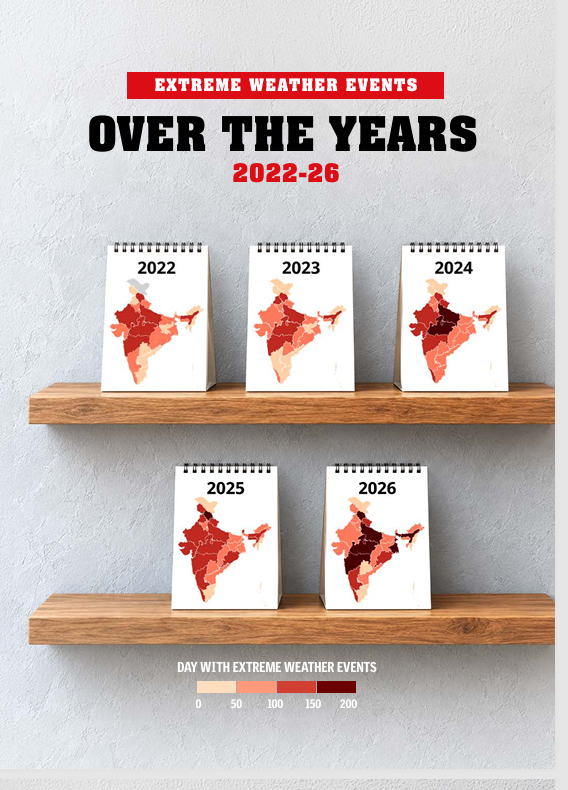
The report’s analysis of 2022 to 2026 shows the problem deepening. The share of days with extreme weather climbed from 86-88 per cent in 2022 and 2023 to 93 per cent in 2024 and 99 per cent in 2025.
Over the five years, extreme weather has killed 16,303 people, nearly 65 per cent of them between 2024 and 2026. Annual deaths rose from 2,755 in 2022 to a peak of 4,064 in 2025.
Crop losses followed the same path. Of the 20.6 million hectares damaged over five years, more than 82 per cent was in the last three. Affected area jumped from 1.84 million hectares in 2022 to 9.47 million in 2025, while 2026’s 4.25 million hectares is the second highest in the period.
- CSE and Down To Earth’s Climate India 2026 report on extreme weather events released.
- India faced extreme weather events on 92 per cent of days in the first nine months of 2026, says the report
- 3,220 lives lost; 4.25 million hectare of crops damaged; 128,334 houses destroyed; 47,244 animals killed
- Uttar Pradesh (UP) and Himachal Pradesh battered the most number of days – maximum number of deaths in UP
- Report lays bare the five-year (2022-2026) trends – clearly shows the increase in numbers, scale etc; no part of the country untouched
The spread is just as telling. In the east and northeast, the share of affected days rose from 63 to 80 per cent. In central India, it went from 73 to 78 per cent. Northwest India peaked at 94 per cent in 2025 before easing to 86 per cent this year, while the south peninsula climbed from 46 to 75 per cent in 2025 before dropping to 64 per cent.
“While the intensity and type of events vary across seasons and regions, no part of the country has remained untouched,” said Kiran Pandey, CSE programme director and lead writer of the report. She warned that with El Niño strengthening and drought persisting across more than half the country, the year has been devastating for farmers, who continue to die by suicide at the rate of one every hour.
Shifting seasons
Winters are warming. The 2026 winter had the second-lowest count of cold wave and cold day events in five years, and February saw none for the first time in that period. Heatwaves arrived early, with Himachal Pradesh and coastal Andhra Pradesh recording episodes.
The monsoon offered no respite. Although the southwest monsoon ended 13 per cent below the long-period average, heavy rain, floods or landslides struck somewhere in the country on all 122 days of the season. The pre-monsoon months were also costly, with at least 0.73 million hectares of crops damaged between March and May, the second-highest figure for that period in five years.
“The new normal”
Down To Earth managing editor Richard Mahapatra, who conceived the report, called the trend “the new normal in a warming world.” He said publicly available data on such events is fragmented, and the report seeks to build a consolidated evidence base.
He argued that India must shift from disaster response to risk reduction and resilience. Flood management, he said, needs robust drainage and water-recharge infrastructure and the restoration of green spaces and forests that act as natural buffers, not just contingency plans.
Narain said the repeated onslaught leaves communities no time to recover before the next event. “Governments are aware of this,” she said, adding that the report is meant to show that this is a pan-India issue, not one confined to a region, a day or a state.
Climate India 2026 is available for free download, and the release webinar proceedings are also online.