For generations, a stretch of National Highway-44 winding through Ramban, Digdol, and Panthyal carried a grim reputation. Locals called it Khooni Nallah — a name spoken with unease, synonymous with falling rocks, sudden landslides, and fatal accidents that could strand travellers for hours or even days at a stretch. That reputation is now giving way to something new.
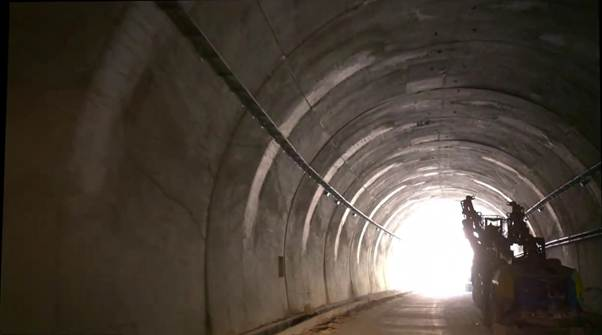
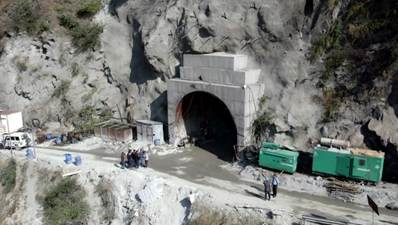
The construction of four-lane twin-tube tunnels between Digdol and Panthyal, part of the broader four-laning of the Ramban–Banihal section of NH-44, is rewriting the story of one of the Himalayas’ most treacherous road stretches. With physical progress at 87.2 percent, the project is in its final stage — and the change on the ground is already being felt.
A Lifeline Through the Mountains
Perched in the upper reaches of the Himalayas, the Ramban–Banihal corridor is the primary road link between the Kashmir Valley and the rest of India. Its steep gradients, unstable slopes, and susceptibility to weather disruptions have long made it both strategically critical and logistically fraught. The ₹866.37 crore Digdol–Panthyal Twin Tube Tunnel project, undertaken by the Ministry of Road Transport and Highways, directly addresses these vulnerabilities.
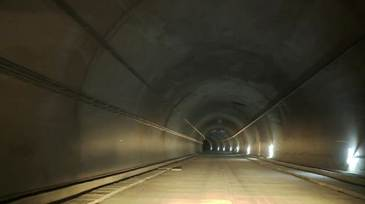
The tunnels — northbound tubes measuring 2.6 km and 0.619 km, and a southbound tube stretching 3.08 km — cut through the mountain rather than across its exposed face, bypassing the landslide-prone slopes that made the old alignment so unpredictable. Construction began in 2022 using the New Austrian Tunnelling Method (NATM), a proven technique for underground excavation in complex geological conditions, with work advancing simultaneously from multiple headings using a combination of heading and benching techniques.
From Days of Waiting to Five Minutes
The shift is most immediately visible to those who live along the corridor. Ratan, a Digdol resident who grew up navigating the old road, describes the difference plainly. Earlier, a rockfall or a spell of heavy rain could bring everything to a standstill — vehicles backed up on both sides, families stranded, schedules upended. “Now, we can reach the Ramsoo–Magarkote side in just five minutes,” he says.
For his neighbour Naresh, the change has been felt most keenly in his children’s daily lives. Accidents were once almost routine on this stretch, and the long, uncertain commute to school in Ramban left children drained before they even reached their classrooms. “By the time they got home, they barely had the energy to study,” he recalls. With travel time to Ramban now cut to roughly five minutes, children are home earlier, less exhausted, and with more hours left in the day. “In the coming years, accidents will reduce further and more time will be saved,” Naresh adds.
Strategic and Economic Dividends
The project’s significance extends well beyond daily convenience. A reliable, all-weather connection along this corridor directly benefits goods transporters, whose deliveries have long been vulnerable to weather-induced closures, as well as tourists and the broader regional economy. For the Army and other security agencies, faster and more dependable movement along this vital artery translates into improved operational readiness and quicker response times in emergencies.
Once fully operational, the tunnels will provide year-round passage shielded from shooting stones and monsoon disruptions — conditions that historically made the open highway alignment both dangerous and unreliable.
A Corridor Transformed
The Digdol–Panthyal tunnels are part of a wider programme of tunnel and bridge construction progressing steadily across the Ramban–Banihal section, collectively aimed at modernising one of India’s most consequential mountain highways. Where travellers once resigned themselves to indefinite waits on a hazardous road, they will soon pass through the mountain in minutes.
For the communities that have lived alongside Khooni Nallah for decades, the transformation is not merely infrastructural. It is the end of a long uncertainty — and the beginning of a road that finally works.