
The Centre on Wednesday informed Parliament that 32 institutions across the country have been identified as fake universities, while cautioning students against misleading advertisements by some EdTech platforms that falsely promise 100 per cent placements and high-paying jobs.
The Government said the University Grants Commission (UGC) has initiated action against unauthorised educational institutions and defaulting EdTech companies that offer or promote unrecognised degree and diploma programmes through franchise arrangements.
Replying to an unstarred question by Rajya Sabha member Sanjay Raut, Minister of State for Education Dr Sukanta Majumdar said the UGC has noticed that some EdTech companies are advertising degree and diploma programmes in Open and Distance Learning (ODL) and online modes in association with universities and institutions recognised or entitled by the Commission.
However, he clarified that such franchisee arrangements are not permitted under UGC regulations.
“The UGC has issued a public notice informing students and other stakeholders that such franchisee arrangements are not permissible and that any programme or degree offered under such arrangements is not recognised by the UGC,” the Minister said.
He added that the Commission has warned that action would be initiated against defaulting EdTech companies and higher educational institutions (HEIs) under the applicable laws, rules and regulations.
The UGC has also advised students and parents to verify the recognition or entitlement status of institutions and programmes on the UGC’s Distance Education Bureau (DEB) website before seeking admission to any course.
Dr Majumdar informed the House that whenever the UGC receives a complaint regarding an unauthorised institution offering degree programmes, it issues a notice seeking an explanation. If the institution fails to provide a satisfactory response, its name is included in the UGC’s list of fake universities.
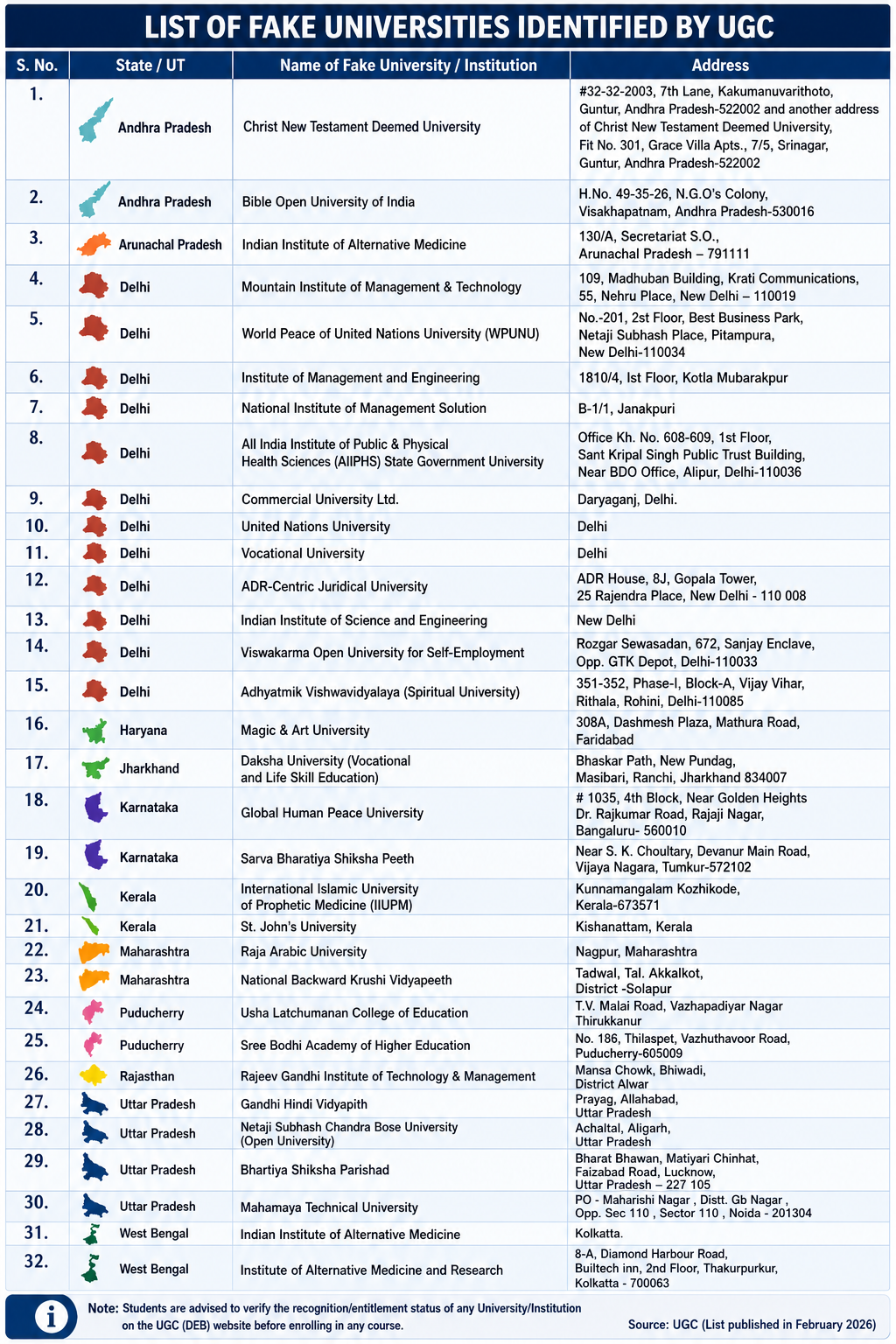
“As per the latest list published in February 2026, 32 institutions have been identified as fake universities,” he said.
To curb the menace of fake universities and unauthorised institutions, the UGC established the Anti-Malpractice Cell (AMPC) on May 30, 1996. The cell deals with complaints relating to fake or unrecognised universities and institutions that offer programmes or award degrees in violation of the provisions of the UGC Act, 1956.
The Minister said the Commission has adopted a multi-pronged strategy to spread awareness and protect students from fraudulent institutions.
The UGC has issued show-cause notices and warning notices to unauthorised institutions awarding invalid degrees, periodically published and updated the state-wise list of fake universities on its official website, and issued public advisories through its website and social media platforms to educate students, parents and other stakeholders.
The Commission has also urged students to verify the credentials of higher educational institutions through the official UGC website before taking admission.
In addition, all State Governments and Union Territories have been requested to initiate appropriate action against fake universities and institutions operating within their jurisdictions and to register FIRs against such entities wherever necessary.
The Government reiterated that students should exercise due diligence before enrolling in any educational institution and verify its recognition status through the UGC to avoid falling victim to fraudulent degree programmes and misleading placement claims.
EOM