
Across India, scientists have found traces of chemical pesticides in the one food meant to be purest: a mother’s milk. Peer-reviewed studies from several states have documented the contamination, and the findings demand urgent attention in Jammu and Kashmir as well.
In Kolkata and Nadia, research published in Environmental Pollution reported organochlorine pesticides, pyrethroids and related chemicals, with higher average concentrations of most substances in Kolkata. In Assam’s Dibrugarh and Nagaon, a study in Science of the Total Environment found residues of DDT and HCH. Another investigation in the same journal documented β-HCH, DDT, DDE, endrin, endosulfan, cypermethrin and chlorpyrifos in breast milk from Punjab. A 2018 study in Archives of Environmental Contamination and Toxicology detected persistent organic pollutants, including DDT and HCH, in samples from Bathinda and Ludhiana. A pilot study in Haryana found p,p’-DDT in 4% and p,p’-DDE in 5% of the samples tested.
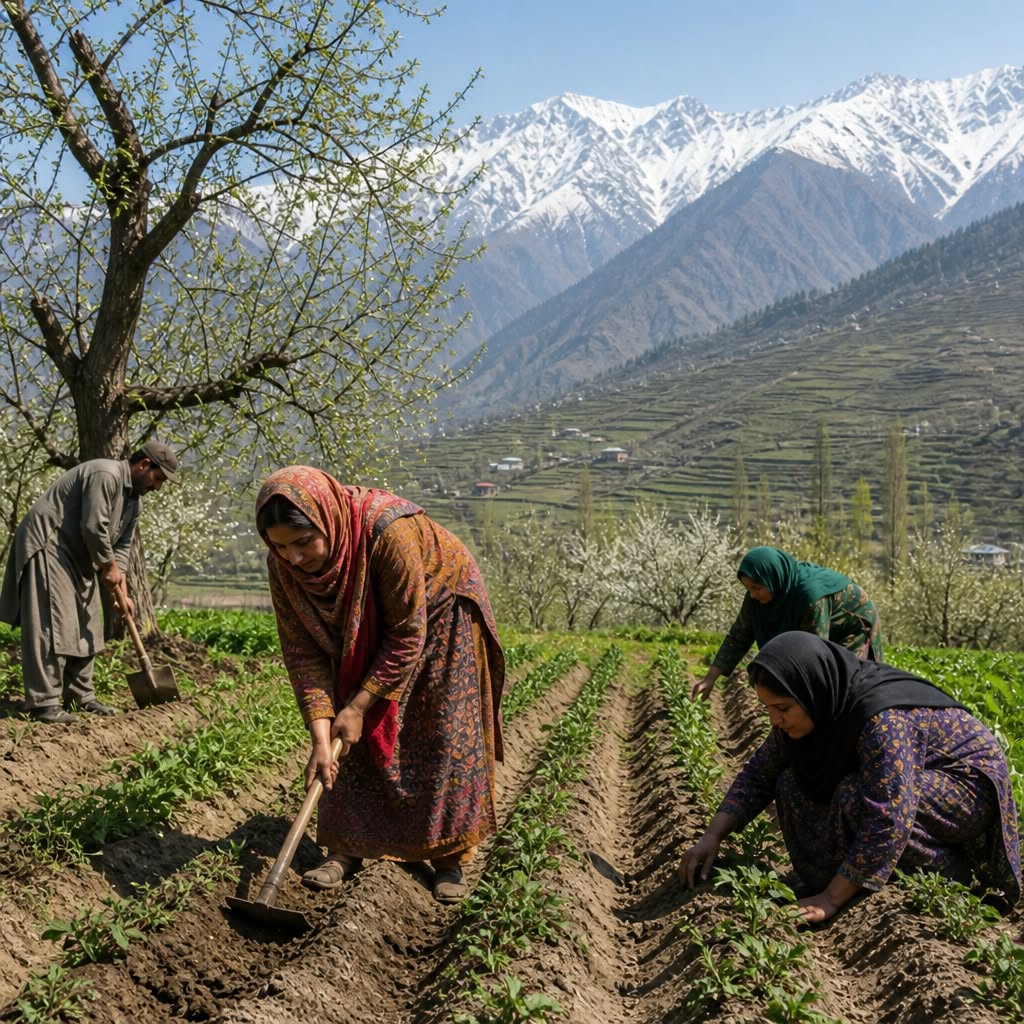
These findings rest on selected samples collected under different research conditions. They do not represent every mother or infant in these regions, nor do they amount to a nationwide estimate. Yet they point to a larger and unsettling reality: persistent pesticides linger in the environment, travel up the food chain and reach even the most vulnerable. In J&K, women work extensively in orchards and fields alongside male family members, and in parts of Jammu province often more than the men. The absence of comparable studies here is a glaring gap.
The region’s orchardists and farmers are widely documented as heavy users of chemical pesticides, fertilizers, herbicides and fungicides. Official agriculture data put the Union Territory’s consumption at about 3.69 kg of chemical pesticides per hectare. That is far above the roughly 0.62 kg in Punjab and Haryana, about 0.50 kg in Himachal Pradesh and the national average of roughly 0.22–0.29 kg. Research linked to the Sher-i-Kashmir Institute of Medical Sciences (SKIMS) estimates that Kashmir’s orchards receive about 7,750 metric tonnes of fungicides and 3,186 metric tonnes of insecticides every year, with farmers often exceeding recommended spray schedules. Nearly 70% of the pesticide applied during sprays is wasted. It stays in the air and soil, or seeps into groundwater and flows into lakes and rivers. Farmers, their families and people living near orchards are therefore exposed through both air and water.
A study in J&K is imperative: it should test for pesticide residues in the breast milk of lactating mothers who work in orchards and fields. Such research would fill a critical knowledge gap. It would also inform public-health policy, occupational safety guidelines and environmental regulation in a region where agriculture and horticulture sustain countless households. The evidence from other Indian states makes the case for stronger pesticide monitoring, safer farming practices, regular testing of food, water, soil and human samples, wider adoption of integrated pest management and strict enforcement of pesticide regulations.
None of this is a reason to stop breastfeeding without medical advice. Pregnant women and lactating mothers should, however, be strongly advised to stay away from fields and orchards where agrochemical use is high. Meanwhile, authorities must accelerate efforts to curb hazardous pesticide use and promote residue-free food. Environment experts are most concerned about the persistence of these chemicals in the environment and the food chain. It is a slow poison, and it demands immediate action, not just committees.
—

Anuj Kumar Verma is an environmental advocate and policy writer based in Jammu, Jammu and Kashmir. His work focuses on pesticide overuse, food safety, pollution and sustainable agriculture in the Himalayan region. Email: [email protected]